Let’s talk about lab grown diamonds – you know, those sparkly beauties cooked up in a science lab instead of being dug out from the deep, dark corners of Mother Earth. Guess what? These guys actually test as real! Yes, you heard it right. Thanks to their carbon structure being nearly identical to their earth-dug cousins, they assume their role with remarkable authenticity.
In recent years, the global lab grown diamond market has continued its rapid expansion. These lab-created wonders have taken centre stage, stealing the limelight as the stars of engagement rings and wedding bands and are valued at approximately $25.7 billion in 2024 and projected to grow to around $38.9 billion by 2029, reflecting strong demand for sustainable and affordable diamond alternatives. Other industry projections suggest the market could approach $74 billion by the early 2030s, driven by broader adoption in fine jewelry and increased consumer awareness of ethical sourcing.
Cracking the Code: How Lab Grown Diamonds Come to Life
How exactly does one whip up a diamond in the lab? It’s all about mimicking the natural process that occurs deep within the Earth, and scientists have two primary methods for doing this: High Pressure High Temperature (HPHT) and Chemical Vapor Deposition (CVD). First up is the HPHT process, which sounds like something straight out of a superhero comic. Picture this: a tiny diamond seed gets tucked into a bed of carbon. It’s then heated to 1,500-1,600 degrees Celsius and compressed to at least 870,000 pounds per square inch (no, we’re not kidding). This high-temperature process causes the carbon to melt and envelop the seed, and voilà, a diamond is born. The next step is just a cool-down, and you’ve got yourself a pure carbon diamond. If you’re not comfortable with extreme heat and pressure, you may prefer the CVD method. Here, a diamond seed is placed in a sealed chamber, which is then filled with a carbon-rich gas (methane, anyone?). The chamber is heated up, but it’s a little less intense, just between 900-1,200 degrees Celsius. The heat breaks down the gas molecules, setting free carbon atoms that can’t wait to latch onto the diamond seed and crystallize. Layer by layer, these atoms build up, and over time, a diamond emerges. Isn’t science amazing?Your Friendly Guide to Diamond Authenticity Checks
Whether lab grown diamonds are born from HPHT or CVD, these man-made sparklers are every bit as real, at least when it comes to their physical, chemical, and optical properties. That means they share the same hardness, refractive index, and shimmering dispersion characteristics. But how do you tell them apart? In the diamond world, there are a few trusty tests that have been used for years to spot a real diamond. These tests are designed to evaluate the diamond’s hardness, its thermal conductivity, refractive index, and specific gravity.- Take the thermal conductivity tester. Diamonds have this cool trait of dispersing heat super-fast, unlike many of their fellow gemstones. This device measures the rate at which heat conducts through a stone and compares it with the rate in a diamond. You’ve got a diamond.
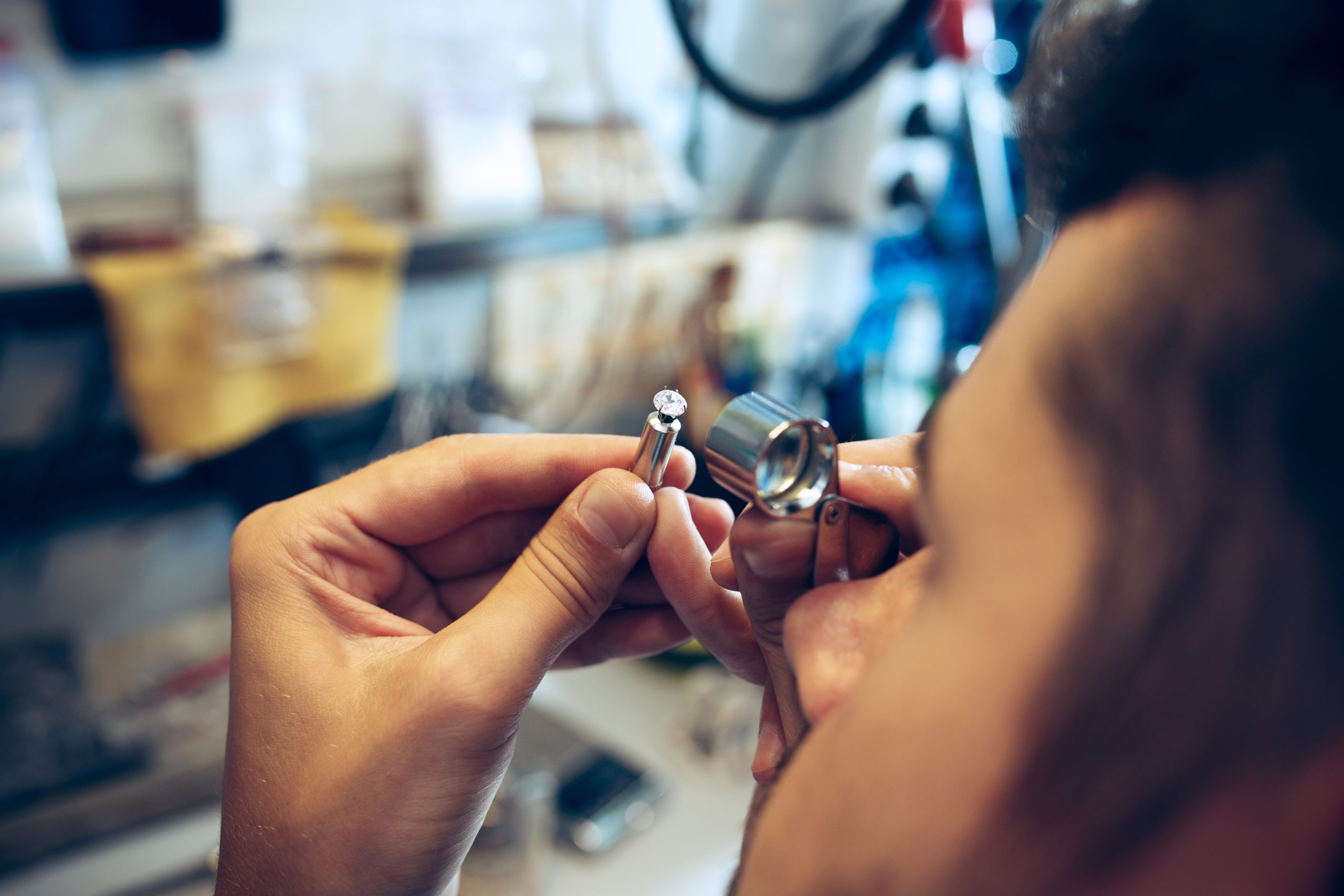
- Another handy tool is the loupe – a souped-up magnifying glass that jewelers love to use. A close examination with a loupe can reveal tiny inclusions that are typically found in natural diamonds.
- And then we have the refractometer, a real gemologist’s best friend. This device measures the diamond’s refractive index, which indicates how much light entering the stone is refracted. Diamonds are known for their high refractive index, which gives them that signature sparkle.
Beyond the Basics: Advanced Tests for Diamond Verification
Today’s savvy diamond detectives have access to some nifty high-tech tools. These machines can spot the unique growth patterns and specific inclusions that mark the difference between natural and lab grown diamonds. For example, HPHT diamonds can sometimes exhibit metallic inclusions not typically found in natural diamonds. In contrast, CVD diamonds may bear tiny grooves or channels as telltale signs of their lab grown beginnings.- One of these high-tech methods is infrared spectroscopy, which checks how diamonds, whether natural or lab grown, absorb infrared light. It does this by shining an infrared light on the diamond and analyzing the reflected light. The tiny differences, caused by minute impurities and structural variations during formation, can be spotted with this technique.
- Another neat trick is laser inscription. A high-precision laser is used to engrave a microscopic identifier (such as a report number, logo, or unique marker) on the diamond’s edge. This doesn’t compromise the diamond’s quality and is invisible to the naked eye, but it can be detected with a 10x magnification loupe or microscope.
- Then we have photoluminescence spectroscopy, another gem from the world of gemological labs. This process exposes the diamond to high-energy light, causing it to emit light at various wavelengths. The light that is emitted can be analyzed to reveal specific atomic structures and defects, which can tell if the diamond is natural or lab grown.
- Lastly, we have the DiamondView instrument, a brilliant invention by De Beers. This device utilizes short-wave ultraviolet radiation to expose the growth structures that distinguish natural from synthetic diamonds. The machine creates a snapshot of the diamond’s structure, which can be examined to figure out