As October’s birthstone, opal is often associated with creativity, individuality, and self-expression. Yet its appeal extends far beyond birthstone traditions.
Depending on the stone and the lighting, an opal can reveal flashes of blue, green, orange, red, or even all of them at once. That shifting appearance has helped make opal one of the most recognizable birthstones and one of jewelry’s most unusual gemstones.
The History Behind Opal’s Appeal
Opals have been admired for thousands of years.
Ancient civilizations often viewed opal as a stone that contained many colors at once. Ancient Romans considered opals symbols of hope and good fortune. In parts of Europe, the gemstone was associated with luck and protection because people believed it carried the colors and powers of other precious stones.
Rather than being defined by a single hue, Opal appeared to borrow characteristics from several gemstones simultaneously. Over time, this unusual quality helped establish opal’s place as October’s birthstone.
The Fire Inside the Stone
The feature that makes opal instantly recognizable is its play of color.
As light enters the stone, flashes of different colors appear and disappear across the surface. One moment you may see green and blue. The next, orange, yellow, or red may become more prominent.
This effect is why opal is frequently associated with fire and light, despite not always having a fiery base color. Some stones produce subtle flashes, while others display dramatic bursts of color that seem to move as the gemstone shifts.
Because every opal develops this effect differently, no two stones look exactly alike. Two gems may share the same shape and size yet display entirely different color patterns.
Types of Opals
Many people picture a white opal when they think of the October birthstone, but several varieties exist.
White opal has a light body color with flashes across the surface, which give it a softer look.
Black opal has a dark background that makes the colors look deeper and more vivid. That contrast is why it is often sought after.
Boulder opal forms within ironstone, so the rock often stays attached and becomes part of the design. It is one of the rarer earth-mined varieties.
Fire opal is valued for its warm yellow, orange, and red body color. Some display play of color, while others are prized primarily for their vibrant hue.
Lab created opal has the same basic makeup as earth-mined opal, with only one primary difference between the two: while mined opals have their origins in the earth, lab created gemstones are grown in a controlled setting.
What to Know About Lab Grown Opal
Lab created opal is made in a controlled setting rather than formed over thousands of years underground. It has the same basic makeup as natural opal, and the play of color is grown into the stone, so the flashes of blue, green, orange, and red look just as striking.
The biggest difference with such lab created gemstones is consistency. Natural opals vary widely, even within the same type, in terms of color, pattern, and the intensity of their play of color, so finding two that look alike can take a long search. Lab created opals tend to show more predictable color, which makes it easier to match a pair of earrings or choose a pendant and ring that look like they belong together.
Lab created opal is often more affordable than natural opal of similar color and size, which leaves more room for the setting or other details of the piece.
How to Style Opal Jewelry
One of the advantages of opal jewelry is that it is usually not tied to a single season or aesthetic.
For everyday wear, opal studs or pendants can introduce color without overwhelming the rest of an outfit. Since opals often contain multiple hues, they pair surprisingly well with different wardrobe colors.
When choosing metals, yellow gold is ideal if you want to highlight the warmer tones in many opals. On the other hand, white metals, such as platinum, emphasize cooler blues and greens. If you are not sure, look at which colors your opal flashes most and choose the metal that matches.
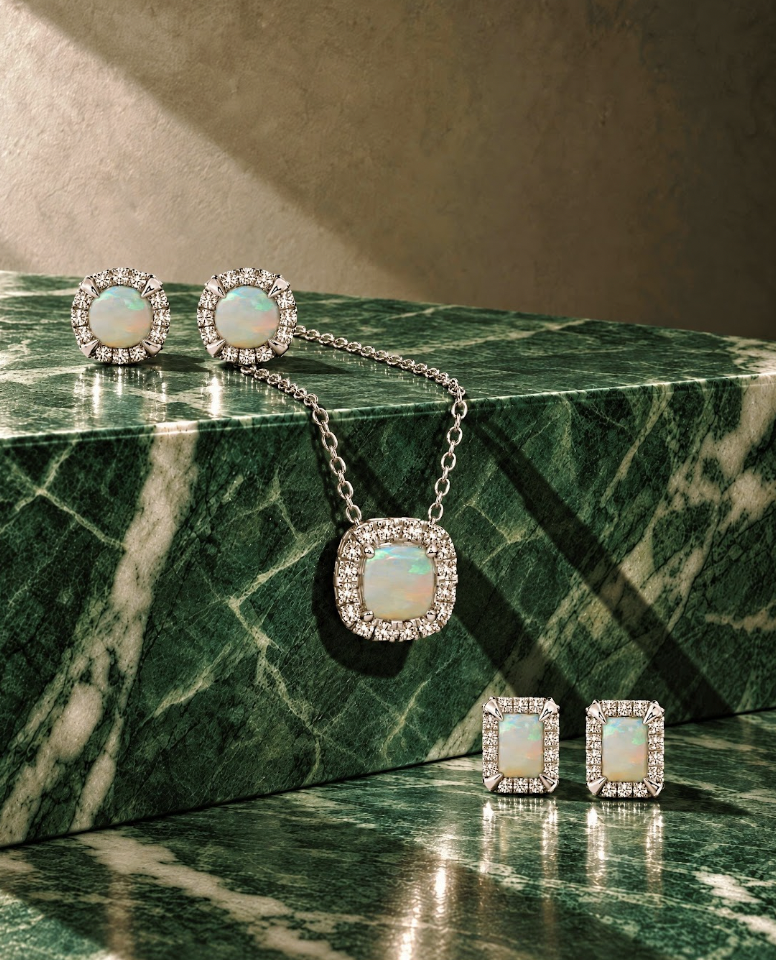
Opals also work well alongside other gemstones. Because opals already display multiple colors, they often complement rather than compete with surrounding stones. Diamond accents are a particularly popular pairing. The Emerald-Cut Opal and Diamond Halo Pendant is one example of how the two lab created gemstones can work together within a single design.
For formal occasions, larger opals are often capable of carrying an entire jewelry look on their own. Their changing colors naturally draw attention without requiring excessive styling.
FAQs
1. Is lab created opal real opal?
Yes. It has the same basic composition as natural opal and shows the same play of color. The difference is that it is grown in a lab rather than formed over time underground.
2. Why is opal associated with fire?
The gemstone’s shifting flashes of color often resemble sparks or flames moving beneath the surface. This has led many to associate the October birthstone, opal, with fire and light.
3. Can I wear opal jewelry every day?
You can, with some care. Opal is softer than most gemstones, so pendants and earrings are generally easier on it than rings. If you do wear opal jewelry daily, take it off before the gym, gardening, or cleaning.
4. How should I clean opal jewelry?
Use a soft cloth and lukewarm water with a little mild soap, then dry it right away. Skip ultrasonic cleaners and harsh chemicals, which can damage the stone.
5. Which gemstones look best next to opal?
Lab grown diamonds are the safest choice since they frame the opal without competing with it. If you want more color, look at which hue your opal flashes most and choose a sapphire, emerald, or ruby to match.